MacBook logic boards, repaired and documented.
4 boards on record 2 chip families last entry 2026-07-26
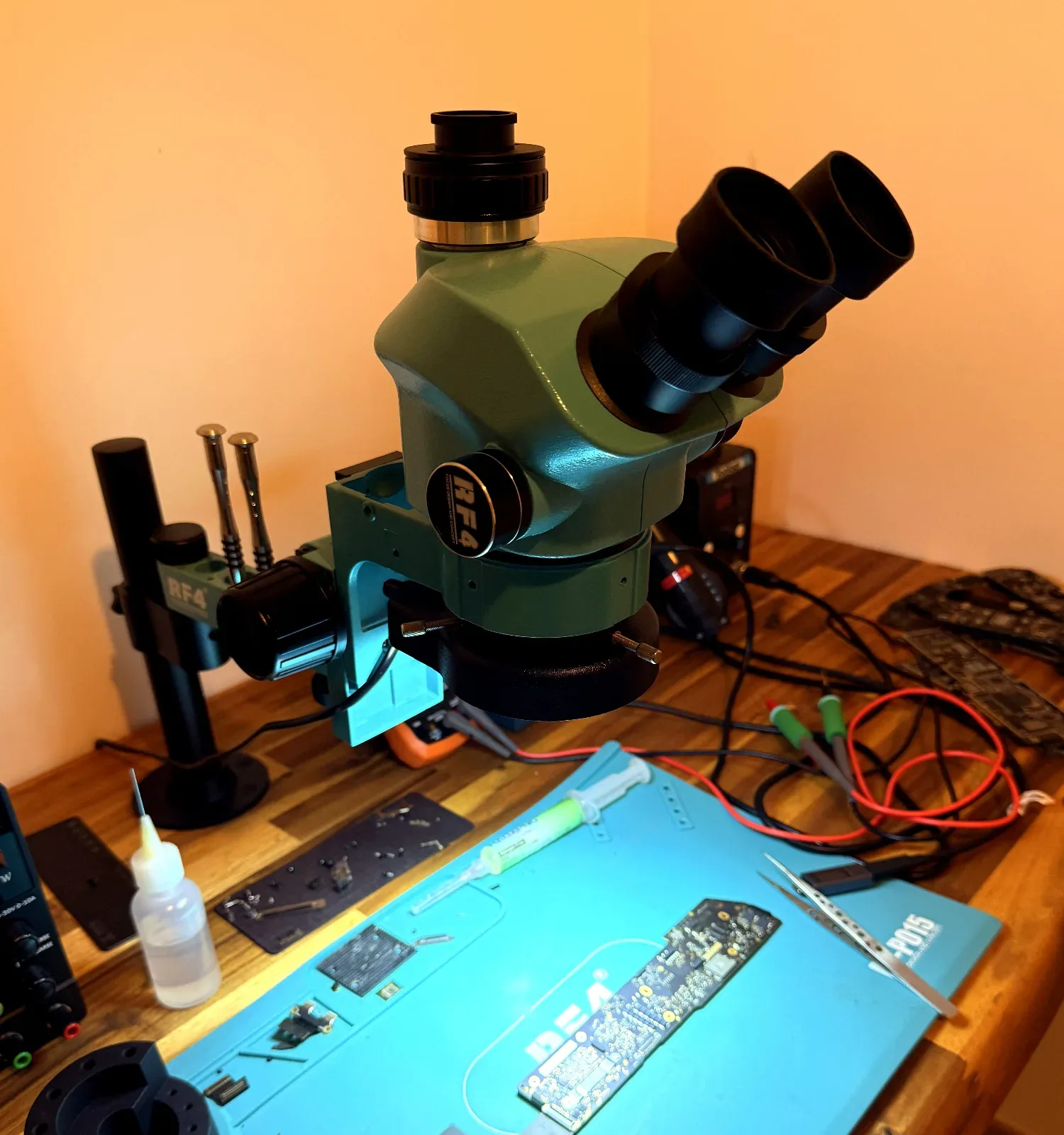
This site isn’t a shop yet: it’s the logbook of a micro-soldering bench. Every board that comes through is written up in detail: the symptom, what the measurements showed, the faulty component, the outcome. Including the ones that end badly.
What came through the bench, in detail.
Not testimonials: the repairs themselves: symptom, measurements, faulty component, outcome, including when it goes badly. It’s the proof we can give you today.
Five symptoms, one logic board, one faulty component.
You don’t need to know what’s broken : that’s our job. You only need to recognise what your machine is doing.
Won’t turn on
No signs of life: no fan, no LED on the charger, black screen. On the bench the current draw says it immediately: 5 V 0.05 A means a missing power rail or a short, not a battery to swap. It’s the most common case, and often one of the cheapest.
USB-CWon’t charge
The battery won’t climb, or the Mac only runs plugged in. Usually the charging circuit on the board (controller, fuse, capacitor) and not the battery itself, which you may already have been sold.
ScreenBlack screen, no image
The Mac starts (chime, fan, heat) but nothing appears. Often the backlight supply or the display line on the board, not the panel itself.
LiquidLiquid damage
Coffee, water, tea. The move that saves it: power off immediately and don’t turn it back on “just to see”. Under power, liquid keeps eating the traces and turns a fixable board into a lost one. Time is against you.
DFUStuck in restore
The Mac does enter DFU, but Revive/Restore fails. It isn’t always the SSD: on several M2 MacBooks that came through here on macOS 26, the block came from the version being restored, not from the hardware. We’ve documented one case in detail.
A logic board carries hundreds of components. Usually, exactly one has failed.
An authorised centre doesn’t repair the board: it swaps it. Faster for them, more expensive for you, and on T2 Macs (2018–2020) as on every Apple Silicon machine, storage is soldered to the board and paired to the security chip. So the new board arrives empty, permanently.
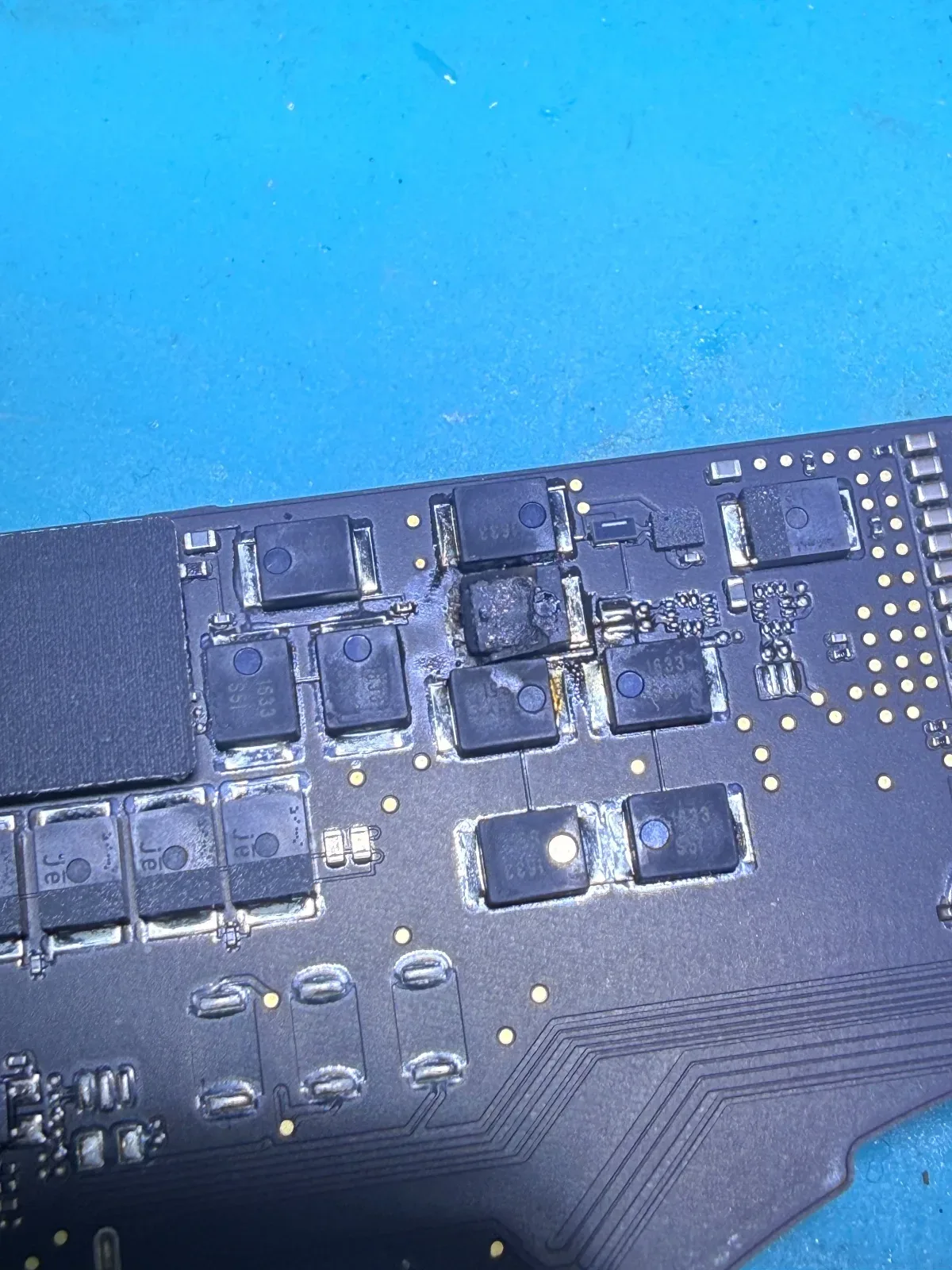
Component-level repair does the opposite: we trace the power rails back to the part that actually failed: a cracked capacitor, a chip no longer receiving its enable signal, a corroded track, and change only that. Your board goes back with your drive and your session on it.
We’re the ones who open your box, and the ones who write back.
No team, no front desk, nothing subcontracted: one person, from the parcel to the reply. When you write, you write to whoever has your board in front of them, not to a call centre that will pass it on.
- The bench
- At home, in the Paris region: stereo microscope, hot-air station, bench power supply, schematics and boardviews for the exact model. No storefront, no counter, and so no commercial rent inside your invoice.
- What we’re not
- Neither an Apple authorised centre nor a shop. If your Mac is still under warranty or AppleCare, go to Apple first: that’s in your interest, not ours.
The workshop isn’t taking repairs yet: opening sometime in 2027. Until then there are no prices, no turnaround times and no commitments on this site, only the record of what was actually done, board by board. You’re welcome to write to [email protected] to talk shop.